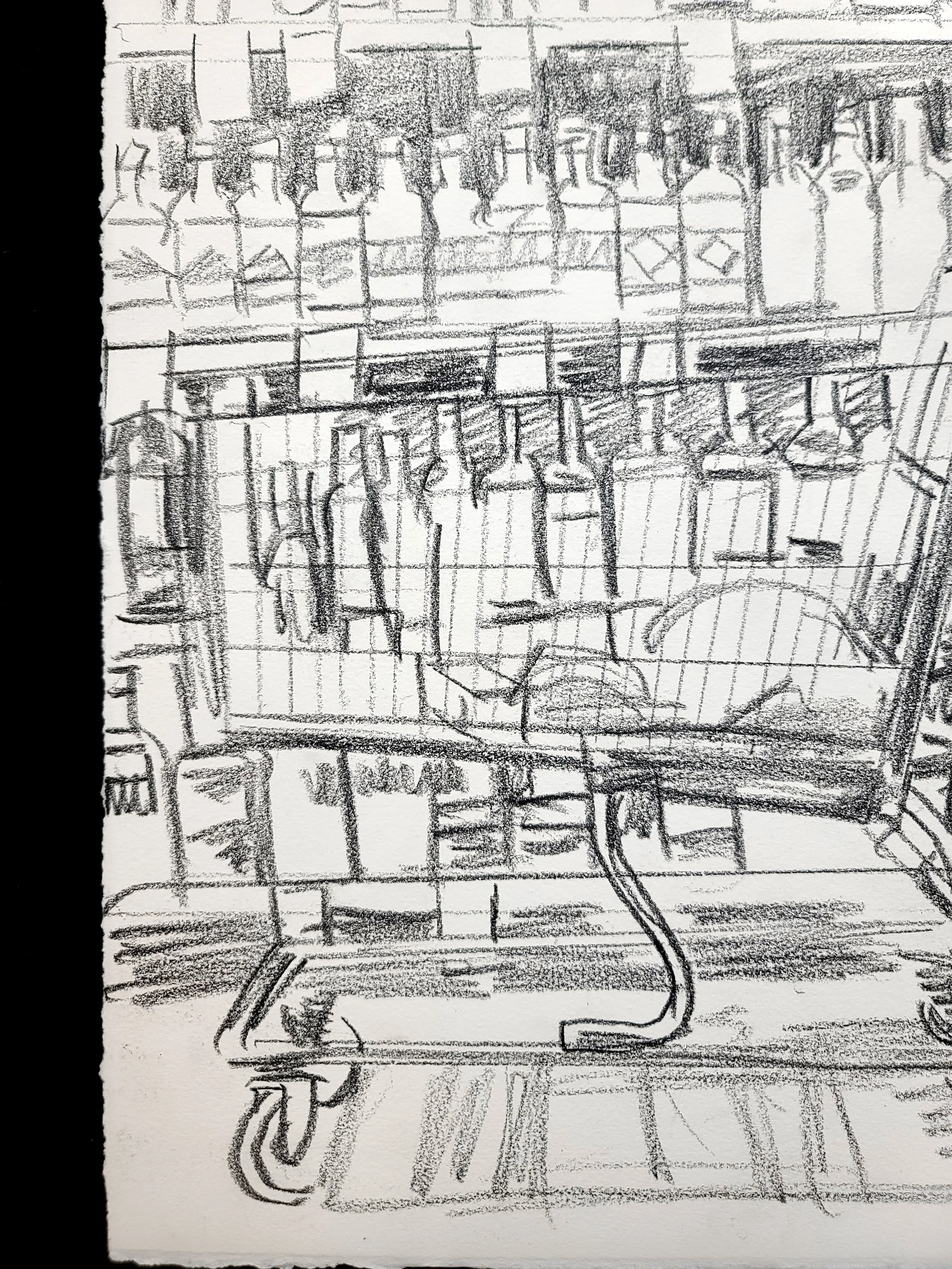
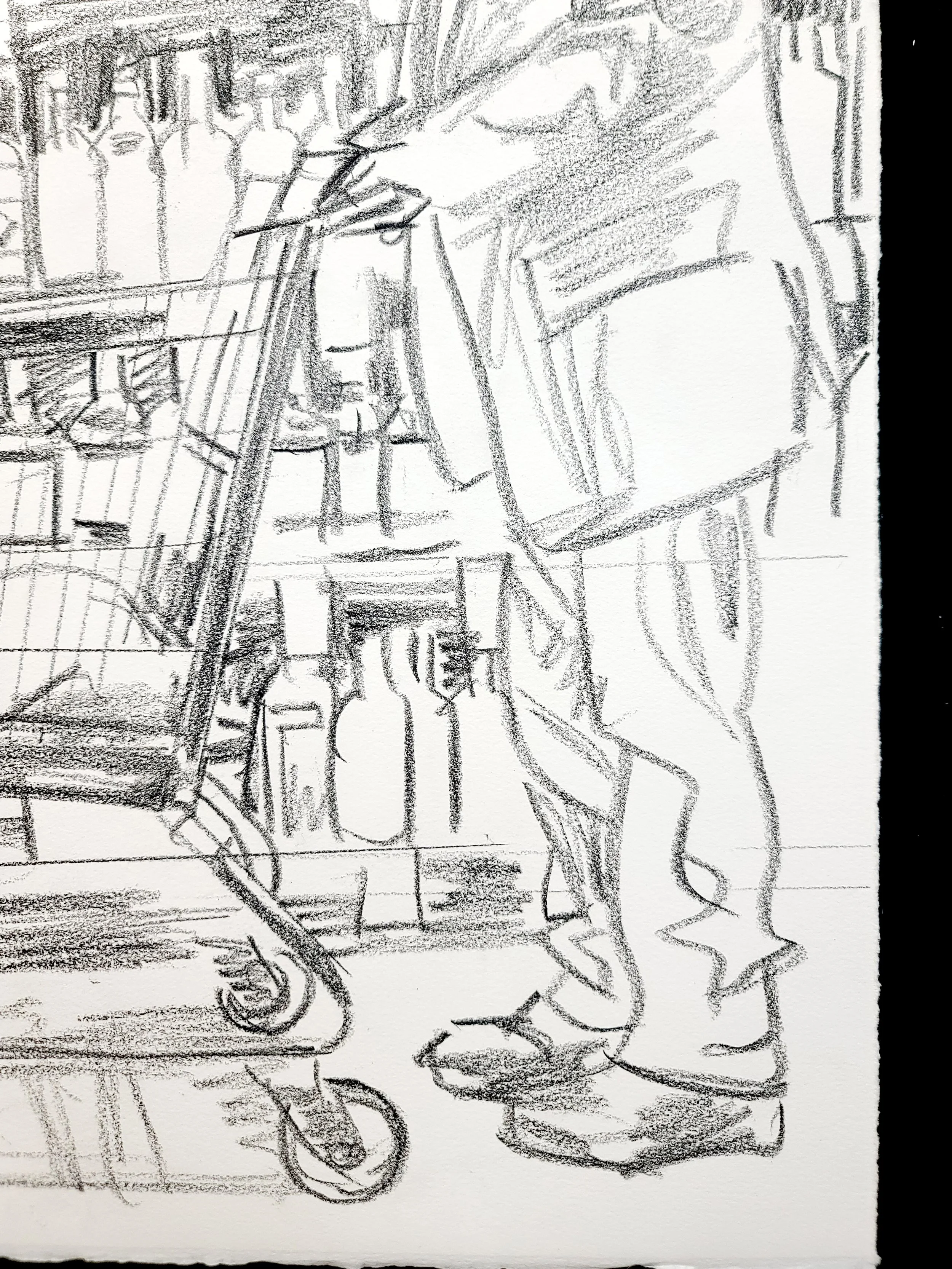
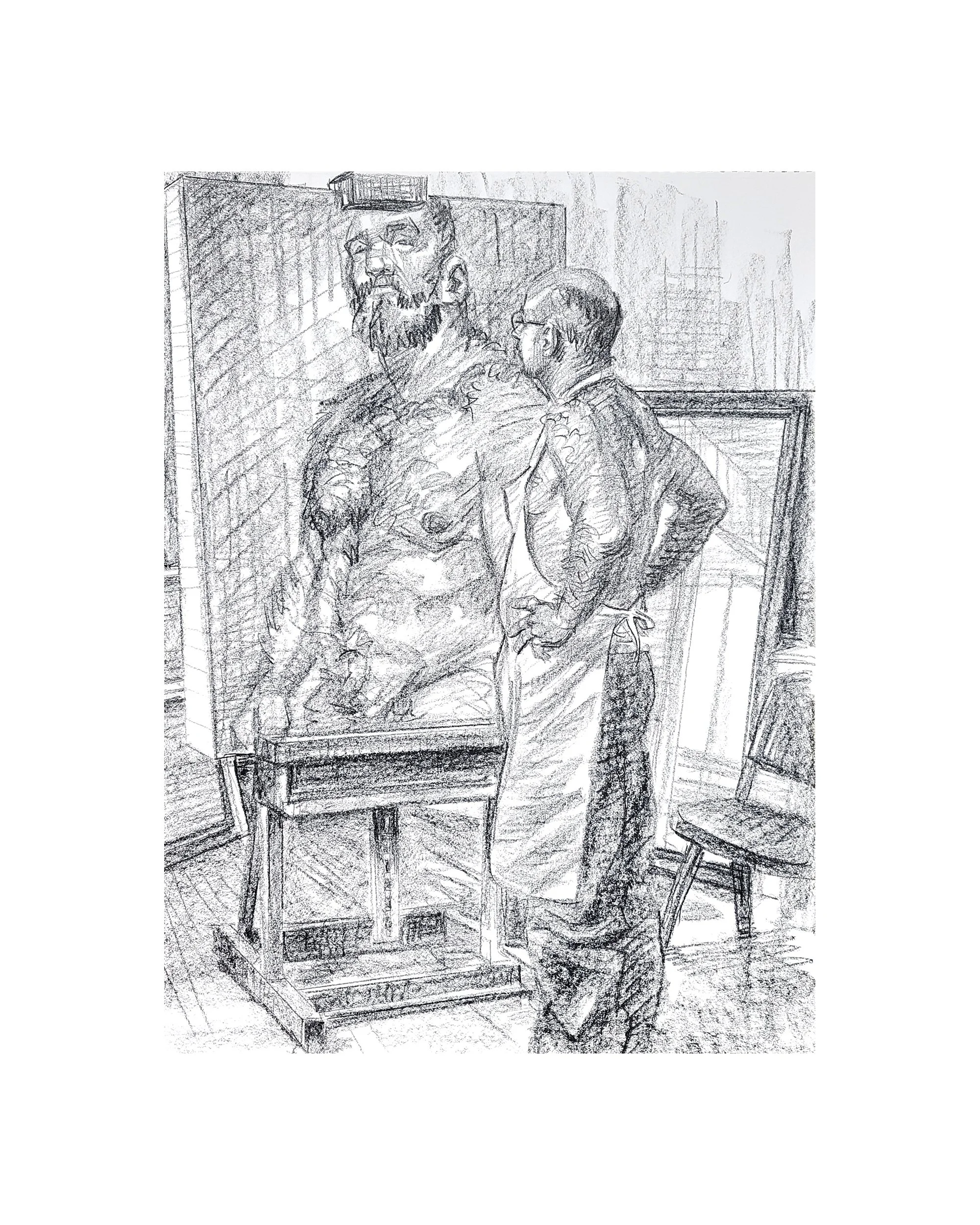
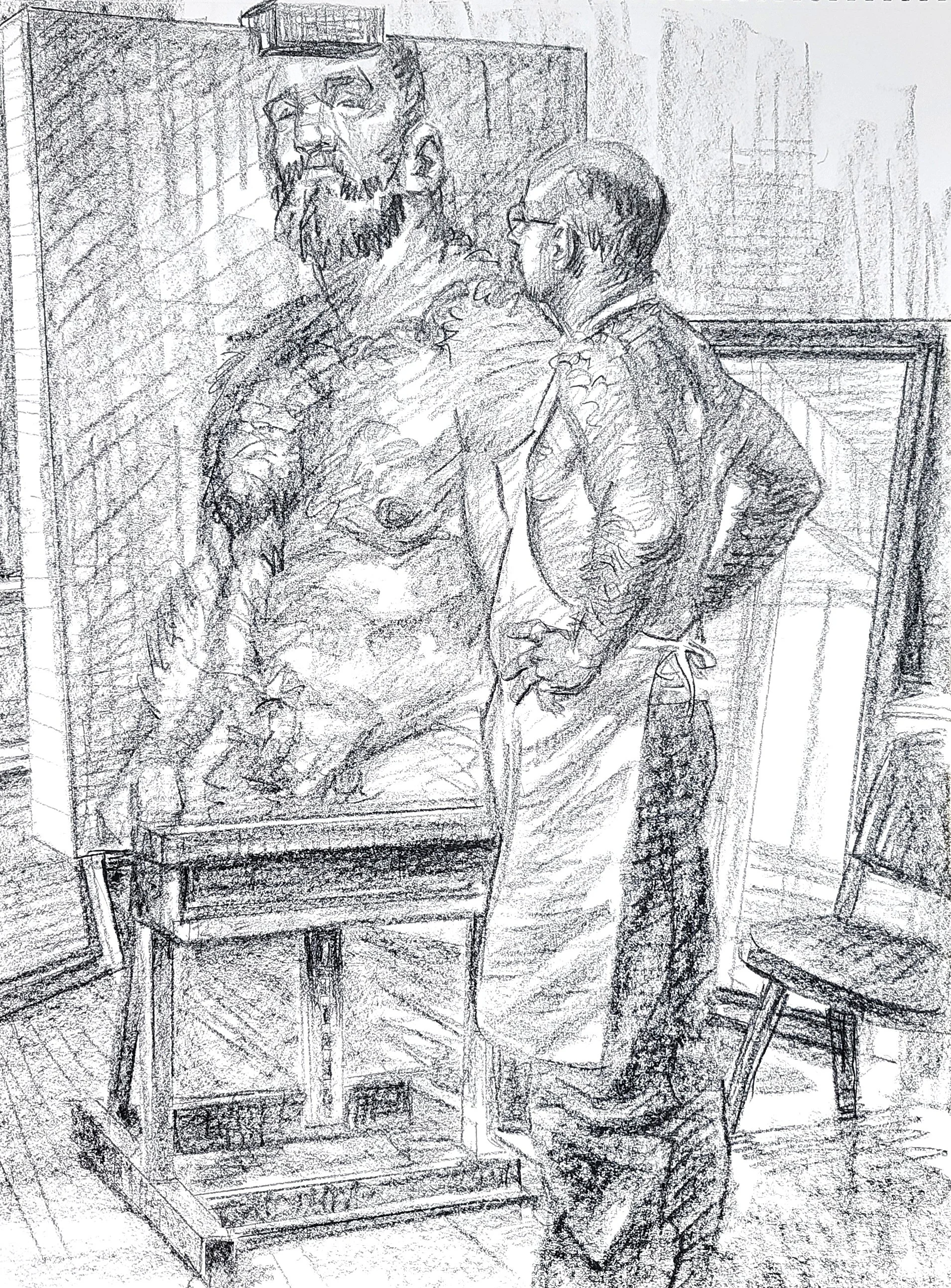
“Self Portrait Seated on Bed in Profile with a Mirror” 36 × 48 × 3 inches, Oil on canvas
This is a handmade, original work of art NOT A PRINT and NOT AI GENERATED
FREE SHIPPING Shipping takes 3–4 Weeks This ships from San Carlos, California (The San Francisco Bay Area). I use UPS and sometimes US Post.
Mirrors and identity are familiar subjects in painting, printmaking, and film. A mirror can offer another view of a person, but it can also raise doubts about what we’re seeing. Is the reflection how I look, how I imagine myself, or how someone else might see me? I’m interested in the gap between those possibilities.
In film noir, a reflection can make that uncertainty visible. Someone can occupy the scene and appear to stand outside it, watching himself. The multiplied images in the hall-of-mirrors sequence in “The Lady from Shanghai” offer an especially dramatic example of how difficult it can become to separate a person from his or her image. My paintings are quieter, but the possibility of seeing myself from outside is part of what interests me. Film reference
Mirrors also have a long association with vanity and self-deception. In Goya’s “Until Death,” an older woman looks into a mirror while younger people behind her suppress their laughter. It’s a harsh image of vanity and aging. That tradition raises an uncomfortable question for me: are we looking honestly at ourselves, or seeing what we want to see? But I’m not interested in making an older body the punch line. Goya reference
I’m also interested in less moralizing uses of reflection. Bischoff’s “Girl with Mirror” belongs to the wider history of painters returning to this ordinary object. Alongside my interest in Paul Cadmus and David Park, it gets me thinking about how a figure occupies a room and how we direct someone’s attention through a painting. For me, a mirror can function as an extra eye. It opens another view within the picture, rather than simply supplying a symbol of vanity. There’s also the “through the looking glass” possibility: a familiar room contains another space that we can see but can’t physically enter. Bischoff reference
Here, my back and profile take up much of the foreground, while my reflected head appears much smaller inside the mirror. The body is close, substantial, and painted in pinks, roses, and deeper plum tones. The bedding and walls are paler, while the yellow light in the mirror gives the reflected space its own presence. The curved frame echoes some of the curves of the body. These formal relationships let the mirror participate in the painting rather than merely illustrate an idea.
Sometimes all this looking at myself feels a little narcissistic. Narcissus was a beautiful young man captivated by his own reflection. I’m an older man, and I’m not mainly trying to make flattering pictures. I’m trying to become more familiar with the person I actually am.
Although these are self-portraits, I also see myself as a stand-in for other men my age. I don’t assume that we all feel the same way, but I hope something in this looking, questioning, and recognition is shared. The more I look at myself, and the more I make images of myself, the more I accept who I am.
 Image 1 of 11
 Image 2 of 11
 Image 3 of 11
 Image 4 of 11
 Image 5 of 11
 Image 6 of 11
 Image 7 of 11
 Image 8 of 11
 Image 9 of 11
 Image 10 of 11
 Image 11 of 11