Pictures of Men, Age, and Everyday Life
Lately I have become more self-directed.
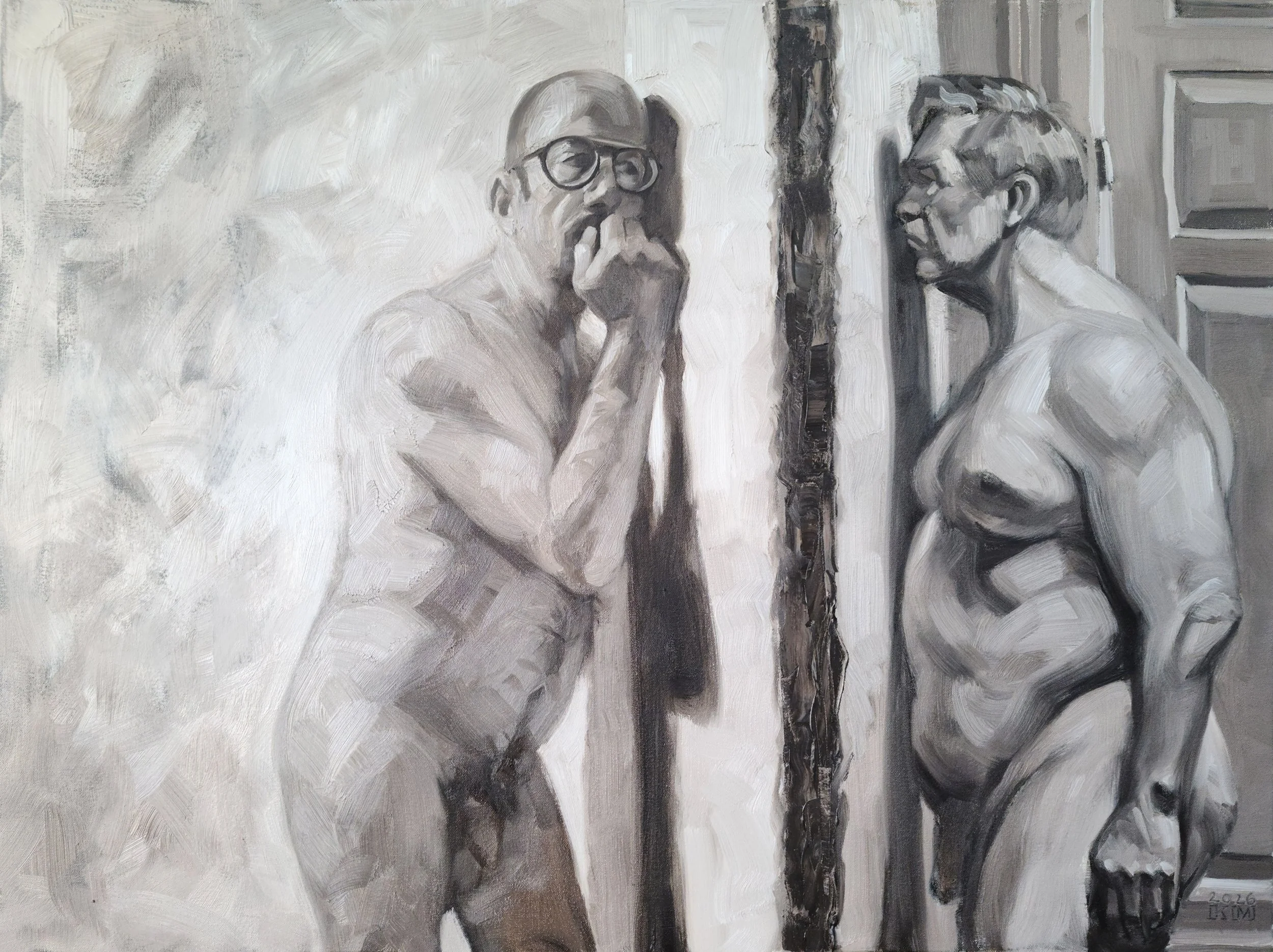
I am working on a personal series of paintings and works on paper about men, aging, private rooms, mirrors, classrooms, memory, and the emotional life of being seen. I have been painting single figures for more than a decade, but these figures feel different to me. Many of them are unvarnished and possibly unflattering self-portraits. Some are alone. Some are in rooms with another figure. Some are in mirrors. They are not meant to provoke desire so much as empathy.
The work is more personal and more autobiographical than much of what I have made before, but I do not think it is only about me. I am interested in the feelings and social situations many people have around aging, the body, private life, status, shame, desire, and our place in the world.
I spent much of the past year traveling through Europe and the UK, looking at the art I had been teaching for more than thirty years as an art historian. I visited museums, churches, cities, old rooms, and public spaces. I kept thinking about who art was made for. So many of the paintings I was looking at were made for patrons: the church, aristocrats, wealthy families, institutions.
That made me ask a simple question: who am I painting for?
One moment stayed with me. I was standing in the crowded, dim room of Goya’s Black Paintings at the Prado. I realized that for much of my career I had been worrying about my audience, especially collectors. When I was in the studio, or even just planning paintings, I often felt as if collectors were looking over my shoulder. When I posted paintings online, I sometimes braced myself for the kinds of responses the images might attract.
I know that once a painting leaves the studio, people will interpret it and use it however they choose. I cannot control that. But this new work is an attempt to paint as if that voice were not in the room.